Cyst Removal in Tokyo: What to Expect at a Dermatologist
Finding a firm lump under the skin is unsettling, and it is even more stressful when you are living or travelling in a country where you are not confident explaining the problem in the local language.
Most of these lumps turn out to be benign skin cysts, but they rarely disappear on their own and they can become inflamed if left alone.
This guide explains what a skin cyst actually is, how dermatologists and plastic surgeons in Tokyo remove them, what the procedure costs under Japan’s public fee schedule, and what recovery realistically looks like.
What you’ll learn in this article:
- What an epidermoid cyst is — and why “sebaceous cyst” is a misnomer
- The two main removal techniques and how they compare on scarring and recurrence
- Realistic cost in Tokyo, including how Japan’s insurance point system works
- What happens before, during and after the procedure, including downtime
- Who is a good candidate, and when removal should be postponed
Have a question about this treatment?
Message us on LINE or WhatsApp — our English-speaking team usually replies the same day.
What Is a Skin Cyst?
The lumps most people call “cysts” are usually epidermoid cysts — small sacs that form in the skin and slowly fill with keratin, the protein that makes up the surface layer of skin. Reference sources describe them as the most common type of cutaneous cyst.
They typically form when the opening of a hair follicle becomes plugged, or when skin cells are pushed into deeper tissue after an injury. Follicular disruption from acne is another recognised mechanism.
Clinical references note that epidermoid cysts most often appear in the third and fourth decades of life and are roughly twice as common in men as in women. They are rare before puberty.
Are they dangerous?
The overwhelming majority are benign. Published reference material indicates that approximately 1% of epidermoid cysts have been noted to undergo malignant transformation, most commonly to squamous cell carcinoma — which is precisely why an unexplained lump should be assessed by a doctor rather than self-diagnosed.
What People Often Get Wrong About Cysts
Misconception 1: “It’s a sebaceous cyst, so it’s full of oil”
This is the single most common misunderstanding. Standard clinical references state plainly that the term “sebaceous cyst” is a misnomer, because the lesion does not involve the sebaceous (oil) gland — it arises from the follicular infundibulum and is filled with keratin, not sebum.
The distinction matters practically. Because the contents are compacted keratin rather than liquid oil, a cyst cannot be “cleared” the way a blackhead can.
Misconception 2: “If I squeeze the contents out, it’s gone”
Squeezing may empty the cyst temporarily, but it leaves the sac — the cyst wall — in place.
Clinical references are consistent that the most effective treatment is complete surgical excision of the cyst with the cyst wall intact, and that incision and drainage alone carries a recurrence risk because the wall remains.
Self-extraction also risks rupturing the sac into surrounding tissue, which can trigger inflammation and make later surgery harder. At BIOTOPE CLINIC in Shirokanedai, patients frequently ask whether a lump can simply be pressed out at home; the clinic group’s own published patient guidance advises against this, noting that delay and self-treatment tend to enlarge the lesion and complicate removal.
How Cyst Removal Works: The Two Main Techniques
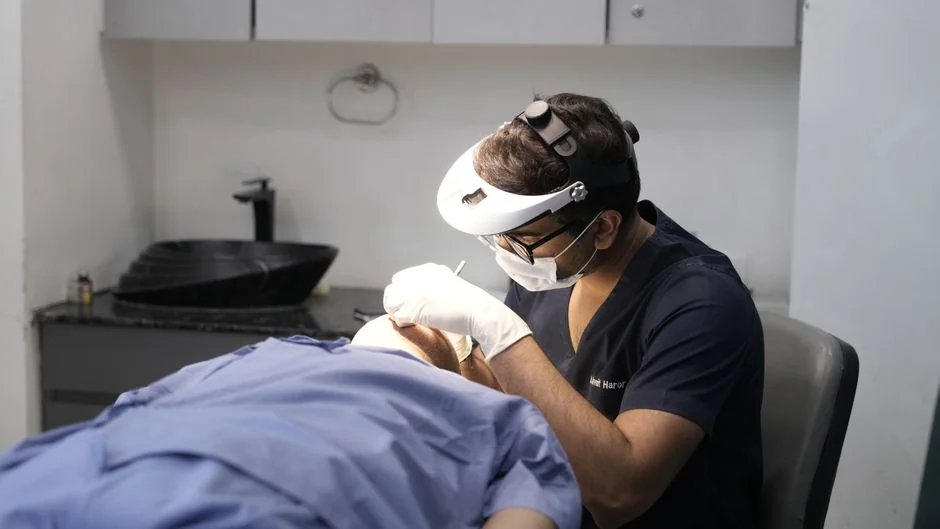
Cyst removal is an outpatient procedure performed under local anaesthetic. Two broad approaches are used, and the choice depends on cyst size, location, and whether inflammation is present.
Conventional (elliptical) excision
The surgeon makes an elliptical incision over the cyst, dissects the sac out whole, and closes the wound with sutures. This gives direct visual control of the cyst wall, but produces a longer linear scar.
Minimal excision / punch techniques
A much smaller opening is made — the classic minimal excision technique described in American Family Physician uses a 2- to 3-mm incision. The contents are expressed, then the cyst wall is grasped and drawn out through the small opening. Many of these small incisions do not require suture closure.
A comparative study of 120 patients published in Archives of Craniofacial Surgery (2019) compared complete surgical excision with a minimally invasive CO2 laser-assisted approach for facial epidermal cysts. Clinical reports of this kind suggest the trade-off is between scar length and recurrence risk.
| Measure (2019 comparative study, 120 patients) | Complete surgical excision | Minimally invasive (CO2 laser) |
|---|---|---|
| Mean scar length at 12 months | 1.23 ± 0.43 cm | 0.30 ± 0.15 cm |
| Mean operative time | 22.38 ± 6.05 minutes | 16.15 ± 5.96 minutes |
| Recurrence (0–12 months) | 3.3% | 8.3% (difference not statistically significant) |
| Haematoma | 5% | 0% |
| Wound dehiscence (wound reopening) | 3.3% | 0% |
| Infection | 3.3% | 1.7% |
In that study the smaller-incision group reported significantly higher satisfaction, while the difference in recurrence did not reach statistical significance. No technique eliminates the possibility of recurrence, and results vary between individuals.
Cost of Cyst Removal in Tokyo
In Japan, removing a cyst for medical reasons is treated as insured surgery, not cosmetic surgery. Fees are set nationally in points, and the Japan Medical Association explains that prices are calculated at 1 point = 10 yen.
Under the fee schedule current at the time of writing (the fiscal 2026 revision), the relevant codes are K005 for “exposed” areas — face, neck, below the elbow, below the knee — and K006 for non-exposed areas. Exposed sites are weighted higher because closure is more technically demanding.
| Site and size | Points | Total fee | Patient share at 30% |
|---|---|---|---|
| Exposed area, under 2 cm (K005) | 1,660 | ¥16,600 | approx. ¥4,980 |
| Exposed area, 2–4 cm (K005) | 3,670 | ¥36,700 | approx. ¥11,010 |
| Exposed area, 4 cm and over (K005) | 5,010 | ¥50,100 | approx. ¥15,030 |
| Non-exposed area, under 3 cm (K006) | 1,280 | ¥12,800 | approx. ¥3,840 |
| Non-exposed area, 3–6 cm (K006) | 3,230 | ¥32,300 | approx. ¥9,690 |
| Non-exposed area, 6–12 cm (K006) | 4,160 | ¥41,600 | approx. ¥12,480 |
These figures cover the surgical fee only. Consultation fees, local anaesthetic, dressings, prescriptions and histopathological examination of the removed tissue are billed separately, so the total at the counter will be higher.
Who pays 30%, and who pays in full
Minato City’s official guide for residents states the co-payment ratio as 20% for preschool age, 30% from school age to under 70, and 20% or 30% for those aged 70 and over depending on income and date of birth.
Foreign nationals whose period of stay is less than three months are not eligible for National Health Insurance, so short-term visitors and medical tourists are generally billed on a self-pay basis rather than at 30%.
Please see the clinic’s official price page or contact us for a current quote regarding self-pay cyst removal. For an accurate quote, please book a consultation.
Have a question about this treatment?
Message us on LINE or WhatsApp — our English-speaking team usually replies the same day.
What to Expect: Before, During and After
Before
The first visit is an examination. The doctor confirms the diagnosis, checks for signs of infection, discusses the technique suited to the site, and schedules the procedure — often on a separate day.
Tell the doctor about blood-thinning medication, allergies to local anaesthetic, and any keloid or hypertrophic scar history, as these affect planning.
During
Local anaesthetic is injected, so the area is numb; patients typically feel pressure rather than pain. In the comparative study cited above, operative times averaged roughly 16 to 22 minutes depending on technique.
After
Expect a dressing, a follow-up visit for a wound check, and suture removal where sutures were placed. The clinic group’s patient guidance describes healing over approximately one to two weeks for a straightforward same-day procedure.
Bruising, mild swelling and tenderness are normal early on. Scars continue to mature and fade over months rather than weeks, and CO2 fractional laser is one of the treatments available at BIOTOPE CLINIC in Shirokanedai for scar texture — feel free to ask about it during a consultation with Dr. Karibe.
Who Is a Good Candidate — and Who Should Wait
Good candidates are generally people with a stable, non-inflamed cyst that is growing, catching on clothing, cosmetically bothersome, or repeatedly becoming sore.
Timing matters when the cyst is inflamed. Clinical references advise that complete excision should be delayed if an active infection is present, because the tissue planes become difficult to identify; the American Family Physician technique article similarly notes it may be preferable to postpone excision until inflammation has subsided. In that situation, drainage and antibiotics may be used first, with definitive removal scheduled later.
Discuss removal carefully if you take anticoagulants, have poorly controlled diabetes, are pregnant, or have a strong tendency to form keloid scars. Any lump that is rapidly enlarging, bleeding, ulcerated or changing in colour warrants prompt medical assessment rather than watchful waiting.
Where to Get Cyst Removal in Tokyo
Within our clinic group, English-speaking consultations are handled at BIOTOPE CLINIC in Shirokanedai (Minato-ku, Tokyo) by Dr. Jun Karibe. Our sister clinic Kojimachi Dermatology & Plastic Surgery Clinic in Ichigaya handles Japanese-language insurance dermatology. Bookings and enquiries in English: LINE or WhatsApp.
Both clinics belong to the same medical group. BIOTOPE CLINIC is a one-minute walk from Shirokanedai Station Exit 1, and its menu includes cyst excision, mole removal and scar revision alongside cosmetic dermatology.
Frequently Asked Questions
- Q. Will the cyst come back after removal?
- Recurrence is possible but uncommon when the cyst wall is removed intact. In the 2019 comparative study, recurrence within 12 months was 3.3% after complete excision and 8.3% after minimally invasive excision, a difference that was not statistically significant.
- Q. Is cyst removal covered by insurance in Japan?
- When performed for medical reasons, removal is an insured procedure under codes K005 or K006. Patients with Japanese public health insurance typically pay 30%, while visitors staying under three months are not eligible for National Health Insurance and are billed on a self-pay basis.
- Q. Does it hurt, and can I go back to work the same day?
- The procedure is done under local anaesthetic, so most patients feel pressure rather than pain, and it is an outpatient treatment. Most people return to desk work quickly, but strenuous exercise, swimming and long baths are usually restricted until the wound has settled.
Have a question about this treatment?
Message us on LINE or WhatsApp — our English-speaking team usually replies the same day.
Summary
Skin cysts are common, usually benign, and do not resolve on their own — the sac has to be removed for the problem to be settled. Squeezing or draining alone leaves the cyst wall behind and invites recurrence.
In Tokyo, medically indicated removal falls under Japan’s public fee schedule, with the surgical fee itself ranging from roughly ¥15,000 at a 30% co-payment depending on size and site, plus consultation, anaesthetic and pathology costs. Short-stay visitors should plan for self-pay.
If you have questions about cyst removal in Tokyo, English-speaking consultations are handled at BIOTOPE CLINIC in Shirokanedai (Minato-ku, Tokyo) by Dr. Karibe. Our sister clinic Kojimachi Dermatology & Plastic Surgery Clinic in Ichigaya (Chiyoda-ku) handles Japanese-language insurance dermatology. English enquiries: LINE or WhatsApp.
24/7 Consultation & Booking
Book a Consultation or Treatment
Our English-speaking team responds via LINE or WhatsApp — usually the same day.
References
- Zuber TJ. Minimal Excision Technique for Epidermoid (Sebaceous) Cysts. American Family Physician. 2002.
- Kim KT, Sun H, Chung EH. Comparison of complete surgical excision and minimally invasive excision using CO2 laser for removal of epidermal cysts on the face. Archives of Craniofacial Surgery. 2019.
- Epidermoid Cyst. StatPearls. StatPearls Publishing. National Center for Biotechnology Information Bookshelf. (https://www.nih.gov/)
- Japan Medical Association. Naruhodo Shinryo Hoshu (Understanding the Medical Fee Schedule) — patient information page on the point system (1 point = 10 yen).
- Ministry of Health, Labour and Welfare. Medical Fee Schedule, fiscal 2026 (Reiwa 8) revision — items K005 and K006, excision of cutaneous and subcutaneous tumours. (https://www.mhlw.go.jp/)
SUPERVISED BY
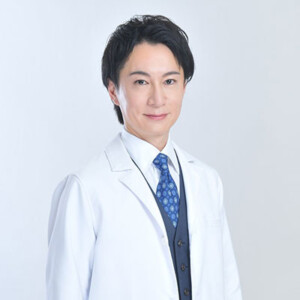
Dr. Jun Karibe
MD
Director
Education & Career
Certifications
Awards
MEDICAL REVIEW