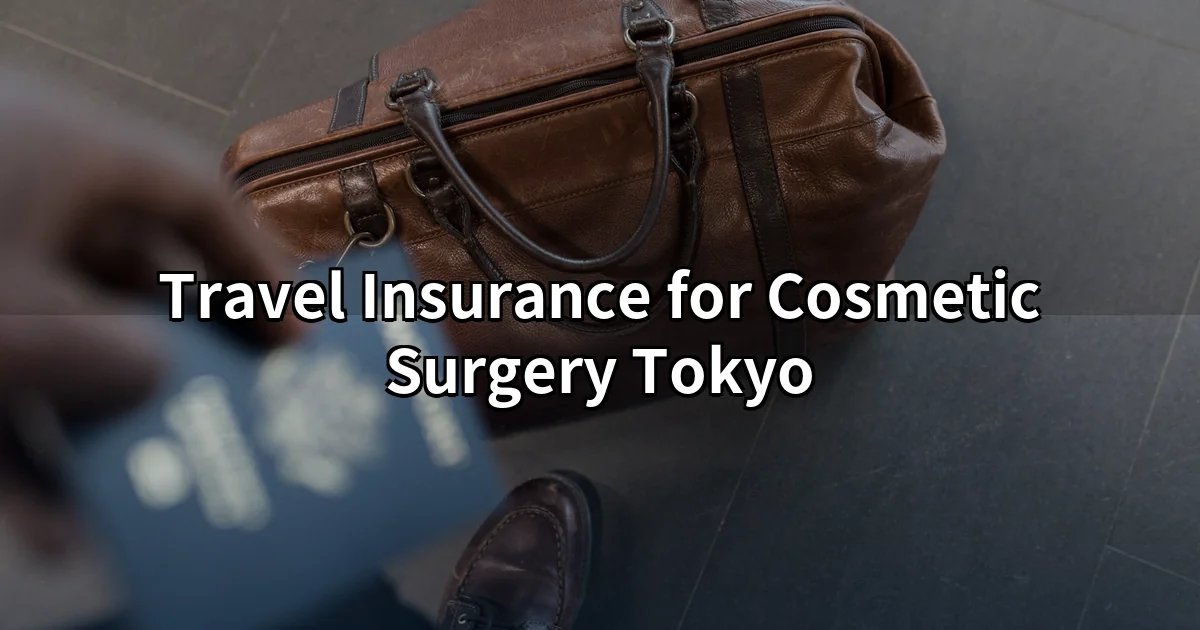
The question comes up in almost every consultation with international patients: “Will my travel insurance cover this?” The honest answer is one of the most surprising things visitors learn about medical tourism — no, standard travel insurance almost never covers elective cosmetic procedures, and it usually excludes complications from those procedures as well. Knowing this in advance changes how you plan, budget, and protect yourself.
This guide explains what standard travel insurance actually covers when you visit Tokyo for cosmetic treatment, what it does not, what a specialised medical tourism policy adds, and what practical steps you can take to protect yourself when policy cover is not available.
Why Standard Travel Insurance Does Not Cover Cosmetic Treatment
Travel insurance policies from providers such as Allianz, AIG, World Nomads, GeoBlue, IMG, and their equivalents are designed to cover unexpected medical emergencies that arise during travel — a broken ankle on the ski slope, a sudden appendicitis, food poisoning that requires hospital admission. The word “unexpected” is the key.
Cosmetic surgery, injectables, laser treatments, and other elective aesthetic procedures are by definition planned in advance. Virtually all standard travel medical insurance policies explicitly exclude:
- Planned or elective surgical procedures of any kind
- Cosmetic surgery and aesthetic treatments
- Complications arising from either of the above
- Follow-up care or revision procedures
- Medical evacuation related to elective treatment
This is not a hidden clause — it is usually in the first page or two of exclusions.
If you travel to Japan on a standard tourist travel policy and receive filler that causes an adverse reaction the next day, the policy will typically decline coverage for both the emergency care and any onward evacuation.
What Standard Travel Insurance Does Still Cover
Understanding what remains covered matters, because it is not “nothing”:
- Unrelated medical emergencies: If you contract influenza during your trip, twist an ankle sightseeing, or need emergency dental care, standard travel insurance still applies as long as the event is unrelated to your cosmetic procedure.
- Trip cancellation and interruption: Covered per policy terms if the cancellation reason meets the covered categories (usually excluding “elective treatment postponed”).
- Lost baggage, delayed flights: Covered normally.
- Personal liability: Covered normally.
What is not covered is anything the insurer can causally link back to your planned cosmetic procedure. Insurers make this determination based on medical records, so the boundary is enforced strictly.
What About Cardholder / Credit Card Travel Insurance?
Complimentary travel insurance included with premium credit cards (American Express Platinum, JCB Platinum, Visa Infinite, etc.) generally follows the same exclusion pattern as standalone policies. Some cards offer meaningful trip cancellation and baggage cover but explicitly exclude elective cosmetic surgery and any complications from it. Read the certificate of insurance rather than the marketing page — the policy terms are what govern claims.
Specialised Medical Tourism Insurance

A separate product category exists specifically for patients travelling internationally for planned treatment. Medical tourism insurance policies explicitly cover:
-
Complications from the covered procedure (typically for 30 to 180 days post-procedure)
-
Revision surgery if the initial result requires medical correction (some policies only)
-
Emergency medical evacuation related to procedure complications
-
Extended hospital stay if recovery takes longer than planned
-
Return travel for unresolved complications
Providers offering medical tourism-specific policies as of 2026 include Global Protective Solutions (CustomAssurance), Passport Health, GeoBlue Voyager, Seven Corners, and several regional providers. Policy structure varies significantly — some are per-procedure, some are per-trip, some require the treating clinic to meet specific accreditation criteria.
Typical price range: USD 300 to 1,500 per procedure or per trip, depending on procedure risk category, coverage limit, and length of post-procedure protection. Higher-risk surgeries (facial contouring, rhinoplasty) sit at the upper end; injectables and skin treatments at the lower end.
What Medical Tourism Insurance Typically Excludes
Even specialised policies do not cover everything. Common exclusions:
- Pre-existing conditions not disclosed at underwriting
- Complications caused by patient non-compliance with aftercare instructions
- Procedures performed by providers not on the insurer’s approved network
- Purely aesthetic dissatisfaction without a medical complication
- Revision requested for cosmetic preference reasons only
- Treatment received while under the influence of alcohol or drugs
- Some policies exclude specific high-risk procedures entirely
The “approved provider” clause is particularly important. If a policy requires treatment at a JCI-accredited facility and your clinic is not JCI-accredited (most excellent private cosmetic clinics in Japan are not), coverage may not apply even if you paid the premium. Read this clause carefully and confirm with the insurer in writing before you commit.
What About Japanese National Health Insurance?
Japanese National Health Insurance (国民健康保険) and Employees’ Health Insurance (健康保険) only cover residents of Japan, not visitors.
Even for residents, cosmetic procedures are explicitly outside the scope of insurance coverage — they are paid out of pocket, at full private rates. This is the same reason our sister clinic Kojimachi Dermatology & Plastic Surgery Clinic handles insurance-covered dermatology in Japanese only, while BIOTOPE CLINIC handles cosmetic and elective work.
Visitors to Japan on tourist status cannot enrol in Japanese public insurance and should not rely on it in any way.
Have a question about this treatment?
Message us on LINE or WhatsApp — our English-speaking team usually replies the same day.
Realistic Ways to Protect Yourself Financially

If specialised medical tourism insurance is not available or not cost-effective for your particular procedure, several practical layers of protection are worth considering:
1. Understand your clinic’s revision policy
Good clinics have written policies covering technical revisions (surgeon returns to the operating room to correct a technical issue attributable to the initial surgery). At BIOTOPE, this policy is discussed openly at consultation and put in writing at booking.
2. Budget a buffer for complications
A practical benchmark: budget 15 to 20% of the procedure cost as an unspent contingency for potential extended stay, additional medication, or minor revision. This is not insurance — it is common-sense financial planning that most patients never touch, but it is available if needed.
3. Confirm hospital access before you fly
For higher-risk surgical procedures (rhinoplasty, facial contouring, blepharoplasty), confirm which hospital the clinic uses if inpatient care becomes necessary. This information should be provided in writing during pre-op planning, not extracted during an emergency.
4. Purchase separate emergency-only travel insurance
Even without cosmetic cover, a standard travel policy still covers unrelated emergencies — a car accident, sudden appendicitis, influenza requiring hospital admission. The premium for a standard policy for a 2- to 4-week Japan trip is small compared to the cost of an unexpected non-elective hospital admission.
5. Use a credit card that offers strong purchase protection
Some credit cards offer purchase protection, dispute resolution, and extended warranty terms that can be useful if a service dispute arises. This is not medical cover, but it can help in commercial disputes.
6. Keep detailed records of everything
Consent forms, pre-op photos, operative report, discharge summary, aftercare instructions, and every follow-up communication. If a complication arises later, your home-country doctors will need this documentation. Ask BIOTOPE for copies of all documents in English before you fly home.
The Practical Questions to Ask Before You Buy Insurance
Before purchasing any policy that claims to cover medical tourism:
- Is my specific procedure covered? (Get this in writing, not verbally.)
- Is my chosen clinic within the approved network?
- What is the post-procedure coverage window (30 days, 90 days, 180 days)?
- Is revision surgery covered, and under what conditions?
- Is medical evacuation to my home country covered, and up to what amount?
- What are the disclosure requirements — do I need to declare specific health history?
- What is the claims process from Japan, and who is the local point of contact?
Ideally, request a specimen policy document (not just marketing material) and read the exclusions before you buy. If an insurer will not provide a specimen policy, that is a warning sign.
Realistic Risk Profile by Procedure
Different procedures carry different insurance calculations:
| Procedure | Complication rate (published) | Practical insurance decision |
| Botox | Very low; bruising most common | Specialised policy usually not cost-effective |
| HA filler | Low; vascular occlusion rare but time-critical | Consider policy if lip or nose filler; low priority for cheek only |
| Thread lift | Low; thread protrusion or dimpling most common | Consider policy; verify revision cover terms |
| Skin treatments | Very low for HydraFacial, low for laser and peel | Specialised policy usually not cost-effective |
| Double eyelid surgery | Low; most complications minor and self-limiting | Strongly consider policy, particularly for incisional method |
| Rhinoplasty | Moderate; revision rate 5 to 15% in published series | Recommended |
| Facial contouring / V-line | Moderate; nerve, infection, and asymmetry issues possible | Strongly recommended |
Common Misconceptions
“Because Japan has universal healthcare, everything is cheaper if something goes wrong.”
Universal healthcare applies to residents only. Visitors are billed at private-pay rates, which for emergency surgical intervention can be substantial.
“My credit card covers medical emergencies overseas.”
Yes, for unrelated emergencies. No, for anything the insurer can causally link to elective cosmetic treatment.
“The clinic will cover complications for free.”
Reputable clinics cover technical revisions attributable to the initial procedure. They do not usually cover unrelated medical costs (a hospital admission for infection, extended anaesthetic care, imaging) — these are billed separately.
“I will just claim it as an emergency and hope for the best.”
Insurers require complete medical records for claims. Any records showing planned cosmetic treatment will be checked against the claim; misrepresentation risks the entire claim being declined and can invalidate future policies.
What BIOTOPE Provides in Writing
Before surgery or major procedures, our English-speaking team provides:
- A written consent form describing the specific procedure planned
- A written aftercare plan with follow-up appointment schedule
- A written revision policy outlining what is included in the initial fee
- Contact information for the hospital used if inpatient care becomes necessary
- English-language copies of all operative and discharge documents on request
All of this is provided at no extra charge and is designed to support your ability to obtain follow-up care in your home country, or to substantiate any insurance claim you may need to make.
Where to Ask More Questions
Our English-speaking team at BIOTOPE CLINIC in Shirokanedai (Minato-ku, Tokyo), directed by Dr. Jun Karibe, board-certified plastic surgeon, is happy to walk through the insurance and revision-policy landscape for your specific procedure before you commit. This is often more useful than reading generic insurance guides, because policy suitability depends heavily on which procedure you are planning.
Message us on LINE or WhatsApp with your travel dates and the treatment you are considering, and we will confirm what documentation we provide, our revision policy for that specific procedure, and what insurance approach we typically see international patients use.
Frequently Asked Questions
Does travel insurance cover Botox in Japan?
No. Standard travel insurance excludes cosmetic injectables and their complications.
Does travel insurance cover complications from rhinoplasty?
Standard travel insurance does not. A specialised medical tourism policy purchased before your trip may cover this.
Can I claim my cosmetic surgery as a medical expense on tax?
This depends on your home country’s tax rules and whether the procedure has a medical indication (not purely cosmetic). Consult a tax adviser in your home country.
Is Japanese travel insurance different from Western travel insurance?
Japanese travel insurance products marketed to outbound Japanese travellers follow similar exclusion patterns. Inbound visitors should use travel insurance sold in their home country.
What happens if I need emergency care after flying home?
You would use your home-country health system or insurance. BIOTOPE provides English-language operative notes and discharge documents to support continuity of care in your home country.
Do you recommend a specific medical tourism insurer?
We do not endorse specific insurers because policy terms change frequently and suitability depends on the individual’s home country, age, and procedure. We recommend obtaining specimen policy documents from two or three providers and comparing coverage line by line.
Summary — The Realistic Plan
Standard travel insurance does not cover elective cosmetic treatment or its complications, regardless of provider or policy tier. If you want financial protection for the specific procedure and its potential complications, purchase a specialised medical tourism policy before you fly. For lower-risk injectables and skin treatments, most patients rely on a combination of the clinic’s revision policy and a small unspent contingency budget rather than a dedicated policy. For higher-risk surgical procedures (rhinoplasty, facial contouring), a specialised policy is worth serious consideration.
Our English-speaking team at BIOTOPE CLINIC in Shirokanedai is happy to review your specific procedure and typical insurance approach used by other international patients from your region. Message us on LINE or WhatsApp with your travel dates and planned treatment, and we will help you plan the documentation and coverage layers that make sense for your situation.
24/7 Consultation & Booking
Book a Consultation or Treatment
Our English-speaking team responds via LINE or WhatsApp — usually the same day.
References
- Sylk Health. Medical Tourism Insurance 2026 Guide. https://sylkhealth.com/blog/articles/medical-tourism-insurance
- World Medical Tour. Medical Tourism Insurance: What Complication Coverage Actually Includes. https://www.wmedtour.com/blog/medical-tourism-insurance-complication-coverage
- WeCovr. Travel Insurance for Medical Tourism — the Botched Surgery Gap. https://wecovr.com/guides/travel-insurance-for-medical-tourism-the-botched-surgery-gap/
- Ministry of Health, Labour and Welfare (Japan). Overview of the Japanese Health Insurance System. https://www.mhlw.go.jp/english/policy/health-medical/health-insurance/index.html
SUPERVISED BY
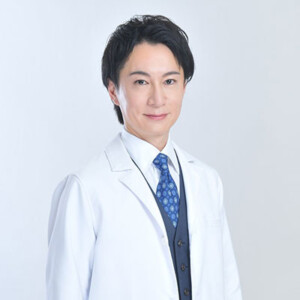
Dr. Jun Karibe
MD
Director
Education & Career
Certifications
Awards
MEDICAL REVIEW