FaceTite vs Surgical Facelift in Tokyo: Which Is Right for You?
Deciding between a minimally invasive procedure and traditional surgery is one of the most common dilemmas facing anyone considering facial rejuvenation.
If you have found yourself researching FaceTite as an alternative to a surgical facelift — wondering whether it can deliver comparable results without general anaesthesia or a lengthy recovery — you are not alone.
This article explains both options in clinical detail so you can arrive at a consultation prepared to ask the right questions.
What you will learn in this article:
- How FaceTite works and what distinguishes it from a surgical facelift
- What results are realistically achievable with each approach, and for whom
- Typical recovery timelines and downtime for both procedures
- Indicative costs in Tokyo for each option
- How to decide which treatment better suits your anatomy, age, and lifestyle
Have a question about this treatment?
Message us on LINE or WhatsApp — our English-speaking team usually replies the same day.
What Is FaceTite?

FaceTite is a minimally invasive radiofrequency (RF)-assisted body contouring device manufactured by IMMODE.
It delivers bipolar radiofrequency energy simultaneously through a small probe inserted beneath the skin and an external electrode placed on the skin surface, creating a controlled thermal field that tightens both the deep tissue and the overlying skin.
Unlike devices that apply energy only from the outside — such as HIFU (High-Intensity Focused Ultrasound) or non-invasive RF — FaceTite works from the inside out. This internal delivery allows it to reach the subdermal layer (the tissue just beneath the skin) and the superficial musculoaponeurotic system (SMAS), which is the same fibromuscular layer that surgeons address during a traditional facelift.
The result is coagulation of fat, stimulation of collagen production, and measurable tissue contraction in areas such as the lower face, jawline, neck, and jowls. Because the incisions required are extremely small — typically 1–2 mm entry points — it is categorised as a minimally invasive procedure, not surgery.
How FaceTite Differs from Embrace RF
Embrace RF is a related technology, also manufactured by IMMode, that combines FaceTite radiofrequency energy with simultaneous microneedling.
At BIOTOPE CLINIC in Shirokanedai, both Embrace RF and FaceTite are available, and Dr. Karibe can advise which protocol is appropriate based on your skin condition and treatment goals.
For patients with significant skin texture concerns alongside laxity, Embrace RF may be recommended in conjunction with FaceTite-based treatment.
What Is a Surgical Facelift?
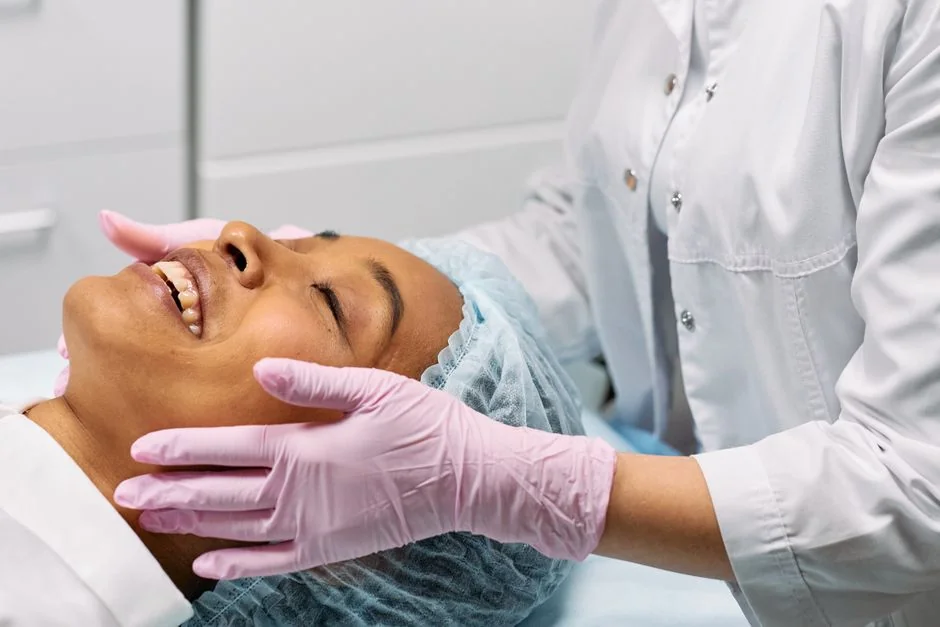
A surgical facelift — technically referred to as a rhytidectomy — involves making incisions along the hairline and around the ears, lifting and repositioning the SMAS layer, removing excess skin, and re-draping the facial tissues.
It is performed under sedation or general anaesthesia and typically takes two to four hours in an operating theatre.
A facelift directly addresses structural facial ptosis (drooping of tissues due to gravity and ageing) in a way that no non-surgical or minimally invasive procedure currently replicates. For patients with significant tissue descent, deep nasolabial folds, prominent jowls, or excess neck skin, a surgical facelift remains the gold standard of facial rejuvenation.
Common Variations of a Surgical Facelift
Facelift techniques vary in scope. A mini-facelift (short-scar facelift) uses shorter incisions and is suitable for earlier-stage laxity.
A full SMAS facelift offers the most comprehensive repositioning and longevity.
A neck lift is often performed in combination to address submental (under-chin) laxity and platysmal banding.
In Dr. Karibe‘s clinical experience at BIOTOPE CLINIC, patients in their late 40s through 60s frequently enquire about whether FaceTite can achieve facelift-equivalent results. The honest answer depends heavily on the degree of skin laxity present at the time of treatment — a point that is always addressed transparently during a surgical consultation.
How Each Procedure Works: The Science

Both FaceTite and a surgical facelift target the same anatomical structures — the SMAS, the subdermal fat, and the overlying skin envelope — but through fundamentally different mechanisms.
FaceTite generates heat through radiofrequency-induced tissue resistance.
As the internal probe passes through the subdermal tissue, temperatures in the target zone reach approximately 65–70°C, a threshold at which collagen fibres denature and contract immediately, while also triggering a wound-healing cascade that stimulates new collagen synthesis over the following three to six months. Clinical reports indicate that FaceTite can achieve measurable tissue contraction of up to 35–40% in treated areas, based on published data from InMode-sponsored trials and independent assessments.
A surgical facelift, by contrast, achieves tissue repositioning mechanically. Excess skin is excised and the SMAS is sutured into a more youthful position — a direct, physical correction rather than a thermal one.
The results are therefore more immediate, more dramatic for advanced laxity, and generally longer-lasting, with published studies suggesting that surgical facelifts maintain visible improvement for an average of 5–10 years depending on technique and individual ageing rate.
FaceTite vs Surgical Facelift: A Detailed Comparison
| Factor | FaceTite | Surgical Facelift |
|---|---|---|
| Invasiveness | Minimally invasive (1–2 mm entry points, local anaesthesia) | Surgical (incisions along hairline/ears, sedation or general anaesthesia) |
| Anaesthesia | Local anaesthesia with tumescent solution | Sedation or general anaesthesia |
| Procedure time | 1–2 hours | 2–4 hours |
| Primary mechanism | Radiofrequency thermal coagulation, collagen stimulation | Mechanical tissue repositioning, skin excision |
| Visible scarring | Minimal (1–2 mm punctures, typically invisible) | Incision scars (well-placed but present; mature over months) |
| Social downtime | 5–10 days (swelling, mild bruising) | 2–4 weeks (significant swelling and bruising) |
| Results onset | Initial improvement at 1–2 weeks; full results at 3–6 months | Visible improvement at 2–4 weeks; full results at 3–6 months |
| Longevity of results | 2–5 years (studies suggest, varies by individual) | 5–10 years (varies by technique and ageing rate) |
| Degree of correction | Mild to moderate laxity | Moderate to severe laxity |
| Risk profile | Low (infection, burns, asymmetry — rare with experienced operator) | Moderate (nerve injury, haematoma, scarring, anaesthesia risks) |
| Suitable age range (general) | Typically mid-30s to early 50s | Typically mid-40s onward, depending on laxity |
| Approximate cost range (Tokyo) | Varies; see cost section below | Varies; see cost section below |
Expected Results: What Is Realistically Achievable?

Studies suggest that FaceTite produces clinically significant improvement in facial contour and skin laxity in the majority of appropriately selected patients. A peer-reviewed study published in the Aesthetic Surgery Journal reported that both patients and physicians assessed meaningful improvement in facial skin laxity following radiofrequency-assisted lipolysis, with high satisfaction rates and minimal serious adverse events.
These figures apply to patients with mild to moderate laxity; outcomes for patients with advanced tissue descent are less predictable with FaceTite alone.
A surgical facelift delivers more dramatic and durable repositioning. However, it does not stop the ageing process, and patients should approach it with realistic expectations. A well-performed facelift can make someone appear a decade younger, but the face will continue to age naturally after the procedure.
The Role of Complementary Treatments
In clinical practice, FaceTite is often combined with other modalities to optimise results.
At BIOTOPE CLINIC, HIFU (High-Intensity Focused Ultrasound), hyaluronic acid filler, and Botox injections are frequently discussed alongside FaceTite to address skin texture, volume loss, and dynamic wrinkles concurrently. A surgical facelift, similarly, may be combined with blepharoplasty (eyelid surgery), fat grafting, or injectable treatments to restore overall facial harmony.
Dr. Karibe’s Note
Many of our international patients arrive having already read extensively about FaceTite and come expecting it to replace a facelift in every situation.
What I try to explain is that the two procedures do not compete — they address different stages of aging.
FaceTite is an excellent option for someone who has mild to moderate jowling and wants meaningful improvement without surgery.
For someone with significant skin excess or deep facial descent, a surgical approach will almost always produce a more satisfying outcome. The most important step is an honest assessment of where you are in your ageing process. A consultation that tells you only what you want to hear is not a good consultation.
What People Often Get Wrong About FaceTite and Surgical Facelifts
Misconception 1: “FaceTite gives the same result as a facelift, just without surgery.”
This is one of the most widely circulated misunderstandings in cosmetic medicine. FaceTite and a facelift do not produce equivalent results for all patients. FaceTite achieves thermal tissue tightening and modest fat reduction, which is genuinely effective for early-to-moderate laxity.
However, it cannot reposition descended facial structures the way surgical dissection and SMAS complication can. For a patient with significant jowling, deep nasolabial folds, or excess neck skin, FaceTite alone is unlikely to produce facelift-equivalent results.
Misconception 2: “A surgical facelift is dangerous and has a long, difficult recovery.”
Modern facelift techniques have evolved considerably. When performed by a board-certified plastic surgeon in an appropriate facility, the risk of serious complications is low. Downtime is real — most patients require two to four weeks before feeling socially presentable — but the majority return to normal activity within one month. The perception of surgery as inherently high-risk can lead some patients to delay appropriate treatment until their laxity has progressed to a point where a more extensive procedure becomes necessary.
Cost of FaceTite and Surgical Facelift in Tokyo
Pricing for both procedures in Tokyo varies significantly depending on the extent of treatment, the experience of the physician, the facility, and whether combination treatments are included. The figures below are indicative ranges to help with planning.
FaceTite at Tokyo clinics typically ranges from approximately ¥300,000 to ¥700,000 for the lower face and neck, depending on the number of areas treated and whether it is combined with liposuction or other modalities. FaceTite is a proprietary medical device procedure and does not fall under Japan’s national health insurance scheme; it is entirely self-pay.
Surgical facelifts in Tokyo at specialist plastic surgery clinics generally range from approximately ¥800,000 to ¥2,500,000 or more, depending on the technique (mini-facelift vs full SMAS facelift), whether a neck lift is included, anaesthesia fees, operating theatre fees, and pre-operative blood work.
At BIOTOPE CLINIC, surgical procedures require pre-operative blood work (¥11,000) and anaesthesia fees (¥2,200–¥77,000 depending on the type and duration). An initial consultation with Dr. Karibe is ¥3,300 for a surgical consultation.
Complementary treatments that are commonly combined with facial rejuvenation procedures include HIFU at ¥25,000–¥110,000, hyaluronic acid filler at ¥66,000–¥88,000 per syringe, and Botox (Allergan) at ¥22,000–¥148,000 depending on the treatment area. Thread lifts (Tesslift) are also available at ¥48,000 per thread as a less invasive volumising complement.
For an accurate quote, we recommend booking a consultation.
Have a question about this treatment?
Message us on LINE or WhatsApp — our English-speaking team usually replies the same day.
What to Expect: Before, During, and After
FaceTite: Procedure Journey
Before: A thorough consultation assesses skin laxity, fat distribution, tissue quality, and the patient’s goals. Pre-treatment photographs are taken. Patients are advised to avoid blood-thinning medications and supplements (aspirin, fish oil, vitamin E) for approximately one week prior. Pre-operative blood tests may be required.
During: The treatment area is numbed with tumescent local anaesthesia — a dilute solution of anaesthetic and adrenaline that minimises bleeding and discomfort. The internal probe is introduced through a 1–2 mm incision, and the physician passes it through the subdermal tissue while monitoring skin surface temperature via the external electrode. The procedure typically takes 60–120 minutes depending on the treatment area.
After: Swelling and mild bruising are expected for five to ten days. A compression garment is typically worn for one to two weeks. Patients are usually able to return to desk work within five to seven days. Strenuous exercise should be avoided for two to three weeks. The tissue continues to contract and tighten over three to six months as new collagen is generated.
Surgical Facelift: Procedure Journey
Before: Comprehensive surgical consultation, medical history review, pre-operative blood work (¥11,000), and in some cases cardiac clearance. Smoking cessation is strongly advised for at least two weeks before and after, as nicotine impairs wound healing and increases complication risk.
During: The procedure is performed under sedation or general anaesthesia. Incisions are made along the hairline, in front of and behind the ear, and sometimes under the chin for a concurrent neck lift. The SMAS layer is lifted and secured, excess skin is trimmed, and wounds are closed with fine sutures. Drains may be placed to prevent fluid accumulation.
After: Swelling, bruising, and tightness are significant for the first two weeks. Most sutures are removed at one to two weeks. Full social recovery typically takes three to four weeks, and final results are visible at three to six months as residual swelling resolves. Sun protection and gentle skincare are essential during healing.
Who Is a Good Candidate?
Ideal candidates for FaceTite are generally adults in their mid-30s to early 50s with mild to moderate facial laxity, some excess submental fat, and good baseline skin elasticity. Patients who are not ready for surgery, cannot take significant time off work, or are managing medical conditions that increase surgical risk may find FaceTite a suitable option. Maintaining a stable weight improves long-term results.
Ideal candidates for a surgical facelift are generally patients in their mid-40s through 60s (or older) with moderate to significant tissue descent, jowling, deep folds, or excess neck skin that cannot be adequately addressed with non-surgical or minimally invasive techniques. Good general health, non-smoking status, and realistic expectations are prerequisites.
Patients who may not be suitable for FaceTite alone include those with substantial skin excess (skin that would need to be physically removed), very thin or very lax skin with poor elasticity, or those who have previously undergone a facelift and have limited residual tissue mobility. These patients may be better served by surgical intervention or a combination approach.
Patients who may not be suitable for a surgical facelift include those with significant cardiovascular or metabolic conditions that increase anaesthesia risk, active smokers unwilling to cease, patients on anticoagulant therapy that cannot safely be paused, or individuals with unrealistic expectations about outcomes.
Where to Get FaceTite or Facelift Consultation in Tokyo
Within our clinic group, English-speaking consultations are handled at BIOTOPE CLINIC in Shirokanedai (Minato-ku, Tokyo) by Dr. Jun Karibe, a board-certified plastic surgeon certified by the Japan Society of Plastic and Reconstructive Surgery.
Our sister clinic, Kojimachi Dermatology and Plastic Surgery Clinic in Ichigaya (Chiyoda-ku), serves as the group’s main office with a focus on Japanese-language, insurance-covered dermatology. All English enquiries — including questions about FaceTite, facelift surgery, and combination facial rejuvenation — should be directed to BIOTOPE CLINIC via LINE or WhatsApp.
At BIOTOPE CLINIC in Shirokanedai, we frequently see patients who have flown to Tokyo specifically for cosmetic procedures, as well as expatriates seeking a long-term aesthetic medical relationship in English. Dr. Karibe’s surgical consultation fee is ¥2,200, and the initial consultation is ¥3,300. Consultations are conducted in English and are conducted without obligation to proceed with any treatment.
Frequently Asked Questions
- Q. Can FaceTite replace a facelift entirely?
- For patients with mild to moderate laxity, FaceTite can produce meaningful and satisfying results that delay or reduce the need for surgery. However, it cannot replicate the degree of tissue repositioning and skin excision achieved in a surgical facelift for patients with significant facial descent. A consultation with a qualified plastic surgeon is the most reliable way to determine which option suits your individual anatomy.
- Q. Is FaceTite painful?
- FaceTite is performed under local tumescent anaesthesia, so the procedure itself should not be painful. Some patients report a sensation of warmth or pressure during treatment. Post-procedure discomfort is generally mild and manageable with over-the-counter pain relief. Bruising and swelling typically resolve within one to two weeks.
- Q. How long do FaceTite results last?
- Clinical reports suggest that FaceTite results are typically visible for two to five years, depending on the individual’s age, skin quality, and rate of ageing. Lifestyle factors such as sun exposure, smoking, and weight fluctuation influence longevity. Complementary treatments such as HIFU or injectables can help maintain results over time.
- Q. Is a surgical facelift available in Tokyo for foreign patients?
- Yes. Board-certified plastic surgeons in Tokyo perform facelift surgery for both domestic and international patients. The key considerations for visiting patients are planning adequate recovery time in Tokyo (a minimum of two to three weeks is advisable), ensuring clear communication in English with the treating surgeon, and understanding the follow-up care requirements. Dr. Karibe at BIOTOPE CLINIC conducts surgical consultations in English.
- Q. Can FaceTite be combined with other treatments on the same day?
- FaceTite is frequently combined with procedures such as submental liposuction, Botox injections, or hyaluronic acid filler on the same visit, depending on the treatment plan agreed during consultation. Combining treatments can improve overall facial harmony and may be more efficient for patients travelling from abroad. Your physician will advise on the safest and most effective combination for your specific case.
- Q. Does Japan’s national health insurance cover FaceTite or facelifts?
- Neither FaceTite nor surgical facelifts performed for cosmetic reasons are covered by Japan’s national health insurance (Kenko Hoken). Both are entirely self-pay procedures. Certain reconstructive plastic surgery procedures may be eligible for insurance coverage under specific clinical criteria, but this does not apply to cosmetic facial rejuvenation.
Have a question about this treatment?
Message us on LINE or WhatsApp — our English-speaking team usually replies the same day.
Summary: Choosing Between FaceTite and a Surgical Facelift
FaceTite is a genuinely effective minimally invasive option for patients with mild to moderate facial laxity who want meaningful improvement without the downtime and risk profile of traditional surgery.
It works through internal radiofrequency energy delivery, achieving subdermal coagulation and collagen stimulation that produces measurable tissue tightening over three to six months. It is not, however, a direct substitute for a surgical facelift in patients with advanced tissue descent or significant skin excess.
A surgical facelift remains the most effective and durable intervention for addressing structural facial ageing. When performed by a board-certified plastic surgeon with appropriate patient selection, it carries a well-established safety profile and results that, studies suggest, can remain visible for five to ten years.
The right choice depends on your anatomy, your stage of facial ageing, your tolerance for downtime, and your aesthetic goals — none of which can be determined without a face-to-face clinical assessment.
Complementary treatments such as HIFU, thread lifts, Botox, and fillers can bridge the gap between purely non-invasive maintenance and surgical intervention, and are worth discussing as part of a comprehensive facial rejuvenation plan.
If you have questions about FaceTite or surgical facelift options in Tokyo, English-speaking consultations are handled at BIOTOPE CLINIC in Shirokanedai (Minato-ku, Tokyo) by Dr. Jun Karibe, a board-certified plastic surgeon certified by the Japan Society of Plastic and Reconstructive Surgery.
Our sister clinic, Kojimachi Dermatology and Plastic Surgery Clinic in Ichigaya (Chiyoda-ku), handles Japanese-language insurance dermatology. English enquiries: LINE or WhatsApp.
24/7 Consultation & Booking
Book a Consultation or Treatment
Our English-speaking team responds via LINE or WhatsApp — usually the same day.
References
- Mulholland RS, Paul MD, Chalfoun C. Noninvasive Body Contouring with Radiofrequency, Ultrasound, Cryolipolysis, and Low-Level Laser Therapy. Clinics in Plastic Surgery. 2011;38(3):503–520.
- Duncan DI. Nonexcisional Tissue Tightening: Creating Skin Surface Area Reduction During Abdominal Liposuction by Adding Radiofrequency Heating. Aesthetic Surgery Journal. 2013;33(8):1154–1166.
- Theodorou SJ, Del Vecchio D, Chia CT. Soft Tissue Contraction in Body Contouring with Radiofrequency-Assisted Liposuction: A Treatment Gap Solution. Aesthetic Surgery Journal. 2018;38(Suppl 2):S74–S83.
- Rohrich RJ, Durand PD, Dayan E. The Ideal Facelift Incision: A Prospective Analysis. Plastic and Reconstructive Surgery. 2020;145(2):306–316.
- Jacono AA, Parikh SS. The Minimal Access Deep Plane Extended Vertical Facelift. Aesthetic Surgery Journal. 2011;31(8):874–890.
Related Articles
You may also find these articles useful.
SUPERVISED BY
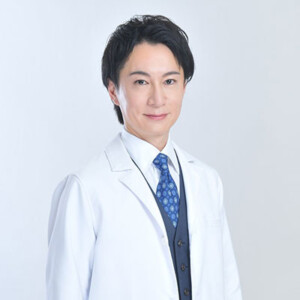
Dr. Jun Karibe
MD
Director
Education & Career
Certifications
Awards
MEDICAL REVIEW