Liposuction Tightening for Abdomen and Thighs in Tokyo: A Complete Results Guide
Many people who eat well and exercise regularly still find that certain areas — the lower abdomen, flanks, inner thighs, or outer thighs — resist change. If you are considering liposuction as a solution, it is natural to wonder exactly what results are realistic, how long recovery takes, and what a procedure in Tokyo will cost.
This guide answers those questions in plain language so you can make an informed decision.
What you’ll learn in this article:
- How modern liposuction works and why it can also tighten skin in some cases
- Realistic results you can expect for the abdomen and thighs specifically
- Typical cost ranges for liposuction in Tokyo
- What to expect before, during, and after the procedure
- Who is — and who is not — a good candidate
- How liposuction compares with non-surgical fat-reduction alternatives
Have a question about this treatment?
Message us on LINE or WhatsApp — our English-speaking team usually replies the same day.
What Is Liposuction, and How Does It Work?
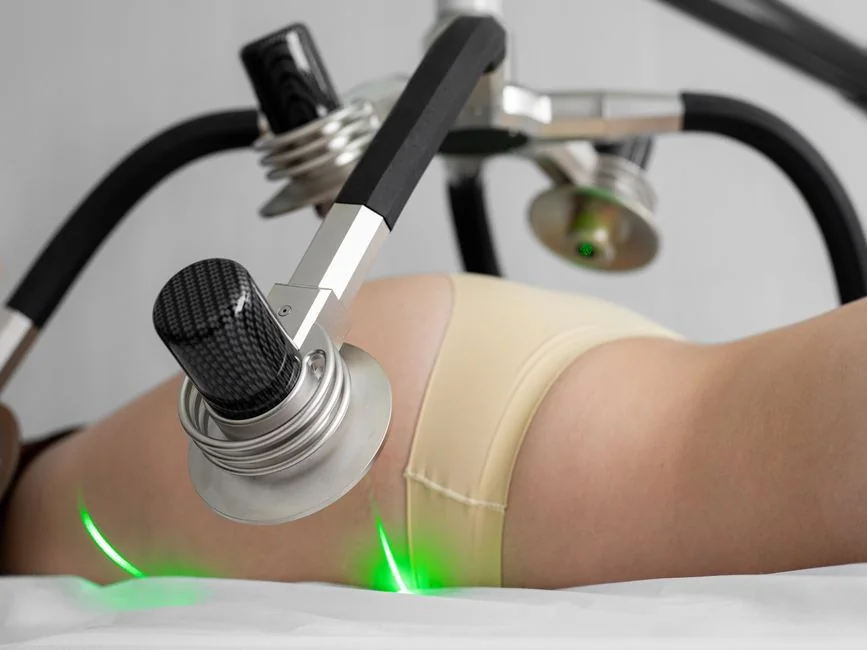
Liposuction (also called lipoplasty or suction-assisted lipectomy) is a surgical procedure that permanently removes localised deposits of subcutaneous fat — the fat that sits just beneath the skin but above the muscle. A thin tube called a cannula is inserted through a very small incision, and fat is broken up and aspirated (suctioned) out of the body.
The key distinction that often surprises patients is that liposuction is not a weight-loss procedure.
It is a body-contouring procedure. The volumes removed are typically measured in hundreds of millilitres, not kilograms, and the goal is to reshape a specific area rather than reduce overall body weight.
Why Does Liposuction Sometimes Tighten the Skin?
Traditional liposuction removes fat but does not directly address the overlying skin. However, modern techniques — particularly those using laser energy (laser-assisted liposuction) or radiofrequency-assisted liposuction (RFAL,Embrace RF) — deliver controlled thermal energy to the undersurface of the skin as the cannula moves through the tissue.
This heat stimulates the production of new collagen and can cause immediate collagen contraction, producing a modest skin-tightening effect alongside fat removal.
Studies suggest that RFAL techniques can lead to measurable improvements in skin laxity.
Clinical reports indicate that procedures such as BodyTite have shown up to 40% skin contraction in treated areas compared with standard liposuction, according to published data from Mulholland et al. (2012).
That said, the degree of tightening is highly variable and depends on the patient’s age, skin quality, and the amount of fat removed.
The Role of Tumescent Anaesthesia
Before fat is removed, the surgeon injects a large volume of a dilute solution — usually saline combined with a local anaesthetic (lignocaine/lidocaine) and a vasoconstrictor (adrenaline/epinephrine) — into the target area.
This is called tumescent technique. It swells the tissue, making fat removal easier, reduces bleeding significantly, and provides local pain control during and after the procedure.
Expected Results: Abdomen and Thighs
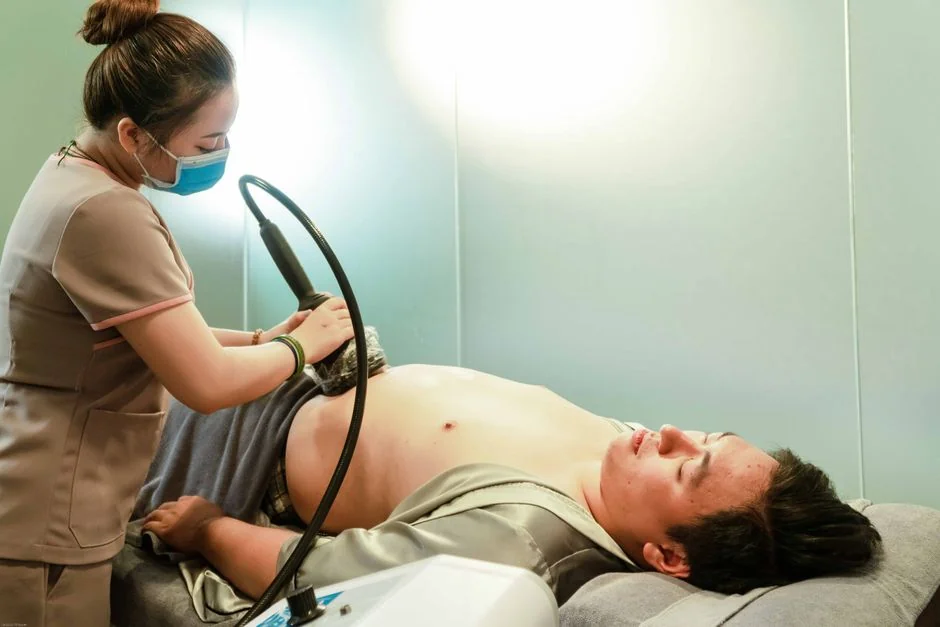
Understanding what liposuction can and cannot achieve for each body region sets realistic expectations and helps prevent post-operative disappointment.
Abdomen
The abdomen is one of the most commonly treated areas for liposuction. The procedure can address both the upper and lower abdomen and the flanks (love handles). Patients with good skin elasticity typically see a noticeably flatter, more defined abdominal contour once swelling subsides — usually at around three to six months post-operatively.
It is important to note that liposuction treats subcutaneous fat only.
Visceral fat (the deeper fat that surrounds the internal organs and causes a firm, rounded abdomen) cannot be removed by liposuction. Patients whose abdominal fullness is primarily visceral will not see the same degree of contour change.
Additionally, if there is significant skin laxity or muscle separation (diastasis recti — a gap between the two vertical abdominal muscles that can develop after pregnancy), liposuction alone will not correct these issues.
A tummy tuck (abdominoplasty) or muscle repair may be a more appropriate option in those situations.
Thighs
Both the inner thighs (medial thighs) and outer thighs (lateral thighs, sometimes called saddlebags) respond well to liposuction. The inner thigh is a technically demanding area because the skin there is thinner and more prone to irregularity if the procedure is not performed carefully. The outer thigh, by contrast, typically has a thicker subcutaneous layer and can tolerate more aggressive contouring.
Clinical reports indicate that patients undergoing thigh liposuction report high satisfaction when candidate selection is appropriate — particularly when skin laxity is mild to moderate. More significant skin sagging may require a medial thigh lift combined with liposuction for optimal results.
In our clinical experience at BIOTOPE CLINIC or Kojimachi Dermatology & Plastic Surgery Clinic, patients who combine thigh liposuction with post-operative compression garments and lymphatic drainage massage tend to recover more smoothly and see earlier resolution of swelling.
Liposuction vs Non-Surgical Fat Reduction: A Comparison
Patients often ask whether they should choose surgical liposuction or a non-surgical alternative. The table below outlines the key differences to help guide that decision.
| Feature | Surgical Liposuction | Fat-Dissolving Injection (e.g. deoxycholic acid) | HIFU / RF Body Tightening |
|---|---|---|---|
| Fat removed | Yes — physically aspirated | Yes — chemically dissolved | Partial reduction via thermal disruption |
| Skin tightening | Moderate (enhanced with RFAL/laser) | Minimal | Yes — primary mechanism |
| Downtime | 1–3 weeks (compression garment 4–6 weeks) | Several days’ swelling per session | Minimal (hours to 1–2 days) |
| Number of sessions | Typically one procedure | Multiple sessions (2–4+) | Multiple sessions (2–4+) |
| Result onset | 3–6 months for full result | 4–8 weeks per session | 3–6 months per course |
| Permanence of fat removal | Permanent (fat cells do not regenerate) | Long-lasting | Modest and may require maintenance |
| Suitable for large volumes | Yes | No — best for small, localised areas | No |
| General anaesthesia required | Sometimes (or IV sedation / local) | No | No |
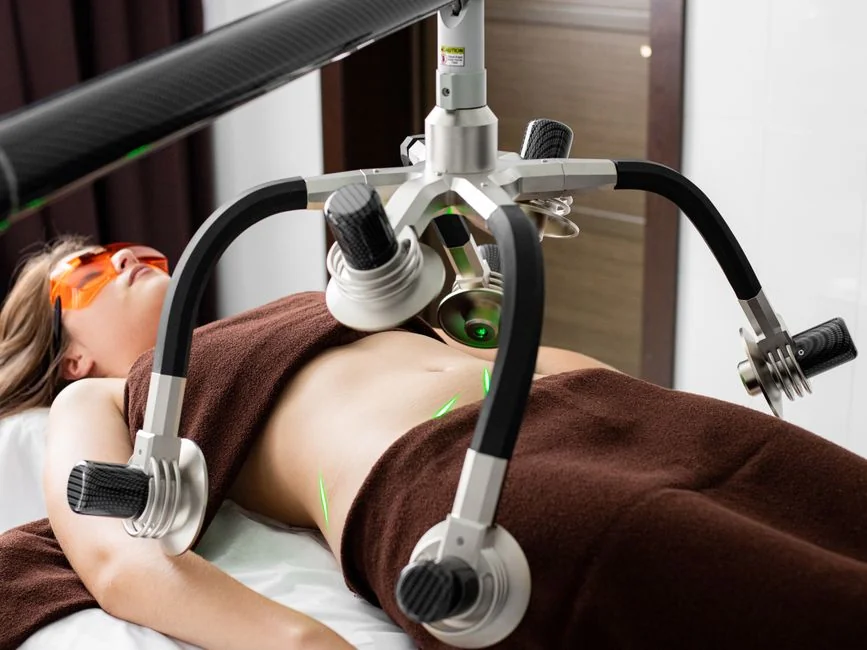
For patients with smaller, more localised fat deposits and good skin tone, non-surgical options such as fat-dissolving injections or HIFU body treatments may offer meaningful improvement with minimal downtime. Both options are available at our Ichigaya clinic — feel free to ask about them during a consultation.
Cost of Liposuction in Tokyo
Liposuction is a cosmetic procedure and is not covered by Japanese national health insurance (NHI). The cost at clinics in Tokyo varies according to the area treated, the technique used, anaesthesia type, and the surgeon’s level of experience.
At Kojimachi Dermatology & Plastic Surgery Clinic, liposuction of the cheek and jawline area is priced at ¥280,000 per area. For body areas such as the abdomen and thighs, pricing is determined on a case-by-case basis following a surgical consultation with Dr. Karibe; the consultation fee is ¥2,200. Pre-operative blood work costs an additional ¥11,000, and anaesthesia fees range from ¥2,200 to ¥77,000 depending on the type and duration required.
As a general market reference, abdominal liposuction in Tokyo at reputable clinics typically ranges from approximately ¥300,000 to ¥800,000 per area, with thigh liposuction in a similar range. Techniques incorporating radiofrequency or laser-assisted skin tightening may add to the base cost.
It is worth factoring in the full cost picture: surgical fee, anaesthesia, pre-operative tests, compression garment, and any post-operative consultations. For an accurate quote, we recommend booking a consultation.
Have a question about this treatment?
Message us on LINE or WhatsApp — our English-speaking team usually replies the same day.
What Is BodyTite?
BodyTite is a minimally invasive radiofrequency-assisted lipolysis platform developed by InMode.
The technology is commonly described as RFAL, meaning radiofrequency-assisted lipolysis or radiofrequency-assisted liposuction.
The BodyTite handpiece includes:
- An internal cannula or electrode placed beneath the skin
- An external electrode positioned on the surface
- Bipolar radiofrequency energy passing between the two electrodes
- Temperature- and impedance-related safety controls
- A treatment field that heats subcutaneous tissue between the electrodes
The internal and external electrodes move together across the treatment area.
Radiofrequency energy produces controlled heating in:
- The subcutaneous fat layer
- Fibrous connective tissue
- Collagen-rich septa
- Tissue near the underside of the skin
The goals may include:
- Coagulation of selected fat tissue
- Improved haemostasis
- Easier fat aspiration
- Contraction of fibrous tissue
- Additional skin and soft-tissue redraping
- Improvement in body contour
BodyTite is intended for larger body regions such as the abdomen, waist, thighs, arms and back. Official platform information describes BodyTite as a minimally invasive RFAL treatment for larger body areas where soft-tissue contraction or haemostasis is desired. (INMODE)
BodyTite vs FaceTite: What Is the Difference?
BodyTite and FaceTite use the same broad RFAL principle, but they are designed for different anatomical areas.
BodyTite
BodyTite is generally used for larger body areas, including:
- Abdomen
- Flanks
- Waist
- Inner thighs
- Outer thighs
- Arms
- Back
- Knees
- Bra-line region
- Selected male-chest concerns
FaceTite
FaceTite is designed for smaller areas, including:
- Jawline
- Jowls
- Submental area
- Lower face
- Upper neck
- Other small, anatomically delicate regions
FaceTite uses a smaller handpiece and internal probe that are more appropriate for facial and small-area treatment. Official product information distinguishes BodyTite for larger body areas from FaceTite for smaller regions. (INMODE)
Therefore, an article about abdominal and thigh treatment should primarily refer to BodyTite, not FaceTite.
FaceTite may be used during the same overall surgical plan when the patient also wishes to treat the lower face or neck, but it is not normally the principal handpiece used across the abdomen or thighs.
Is BodyTite the Same as Liposuction?
Not exactly.
BodyTite describes the radiofrequency-assisted component of the treatment.
Liposuction describes the mechanical removal of fat through a suction cannula.
These procedures are often combined.
A typical treatment may involve:
- Tumescent anaesthesia
- Subdermal BodyTite RF treatment
- Coagulation and thermal remodelling of the target tissue
- Aspiration of fat with a liposuction cannula
- Compression and postoperative care
In some cases, RF treatment may be performed with limited fat aspiration when tightening is the primary objective.
In other cases, more substantial liposuction is performed after the RF treatment.
The appropriate balance depends on:
- Fat volume
- Skin laxity
- Treatment area
- Tissue thickness
- Surgical goals
- Previous procedures
- Patient health
- Surgeon technique
How BodyTite Works
BodyTite uses bipolar radiofrequency delivered between an internal and external electrode.
The internal probe is inserted into the subcutaneous plane through a small incision. The external electrode remains in contact with the skin surface.
Energy travels through the tissue between the two electrodes.
This configuration is intended to produce a controlled three-dimensional thermal effect rather than sending energy broadly through the body toward a distant return pad.
Fat Coagulation
Heating may disrupt or coagulate selected fat tissue.
The treated fat can then be removed through liposuction.
BodyTite should not be described simply as “melting all the fat.” The tissue response is more complex and includes thermal coagulation, mechanical disruption and surgical aspiration.
Collagen Contraction
Heat can alter the structure of collagen-rich tissue.
When an appropriate thermal threshold is reached for a sufficient period, collagen may contract.
This can create an early tightening effect.
Longer-Term Collagen Remodelling
Thermal treatment also activates a wound-healing response.
Over the following months, this may involve:
- Fibroblast activity
- Collagen deposition
- Collagen reorganisation
- Soft-tissue contraction
- Gradual skin redraping
Coagulation of Small Blood Vessels
RF energy may coagulate small vessels in the treatment plane.
This may help reduce bleeding in selected cases, although bruising and haematoma remain possible.
Early RFAL research described the ability to heat tissue while monitoring temperature- and impedance-related parameters, with observed contraction of dermal and adipose tissue. (PMC)
Does BodyTite Monitor Temperature?
BodyTite systems are designed to monitor treatment conditions through internal and external temperature controls and tissue-impedance information.
This is intended to help the practitioner:
- Maintain energy within the planned range
- Reduce uncontrolled overheating
- Limit excessive epidermal temperature
- Deliver heat more consistently
- Stop energy delivery when programmed thresholds are reached
However, no safety system eliminates the possibility of:
- Burns
- Hot spots
- Fat necrosis
- Skin injury
- Nerve injury
- Excessive fibrosis
Safe treatment still depends on:
- Correct tissue plane
- Continuous handpiece movement
- Appropriate energy settings
- Careful monitoring
- Adequate tissue thickness
- Knowledge of local anatomy
- Practitioner experience
How Much Skin Tightening Does BodyTite Produce?
This is one of the most important questions—and one of the most frequently exaggerated.
Some promotional materials and early publications cite skin-contraction figures of approximately 30% to 40%.
These figures should not be interpreted as meaning:
- Every patient’s skin becomes 40% tighter
- The circumference decreases by 40%
- Forty percent of loose skin disappears
- BodyTite reproduces 40% of a tummy-tuck result
- Every anatomical area responds identically
Skin contraction has been measured in different ways across studies, including:
- Surface-area reduction
- Linear skin-distance reduction
- Three-dimensional photography
- Circumference change
- Physician grading
- Patient satisfaction
- Histological change
These outcomes are not interchangeable.
In an early BodyTite clinical series, patient satisfaction was reported as 82% for skin tightening and 85% for overall contouring. Independent surgeons rated skin-tightening improvement as good to excellent in 58.5% of patients. Major and minor complications were also reported, showing that RFAL is not risk-free. (PubMed)
A comparative study of upper-arm treatment found greater measured surface-area reduction with RFAL than with suction-assisted liposuction at one year. However, this study involved the arms rather than the abdomen or thighs and included a limited patient group. (PMC)
The scientifically responsible conclusion is:
BodyTite can produce greater soft-tissue contraction than liposuction alone in selected patients, but the amount is variable and cannot be guaranteed.
Who Is Most Likely to Obtain Good Skin Contraction?
More favourable factors include:
- Mild to moderate skin laxity
- Good remaining elasticity
- Localised subcutaneous fat
- Stable body weight
- Limited stretch marks
- No major history of massive weight loss
- No severe sun damage
- No nicotine use
- Adequate tissue thickness
- Realistic expectations
Less favourable factors include:
- Severe skin excess
- Extensive stretch marks
- Thin, crepey skin
- Major post-pregnancy laxity
- Significant muscle separation
- Massive weight loss
- Multiple previous operations
- Poor wound healing
- Ongoing nicotine exposure
- Unstable weight
BodyTite sits between conventional liposuction and excisional surgery.
It may improve mild or moderate looseness but cannot reliably correct skin that needs to be physically removed.
What Results Can BodyTite Achieve on the Abdomen?
The abdomen is one of the most frequently treated body-contouring areas.
BodyTite-assisted liposuction may improve:
- Lower-abdominal fullness
- Upper-abdominal subcutaneous fat
- Flank fullness
- Waist definition
- Mild skin looseness
- Localised post-pregnancy fat
- Mild contour irregularity
- Definition between the abdomen and hips
The final result depends on whether the abdominal prominence is caused by superficial fat, visceral fat, muscle separation, loose skin or several factors at once.
Subcutaneous Fat vs Visceral Fat
Liposuction treats subcutaneous fat.
This is the fat located:
- Beneath the skin
- Above the abdominal muscle wall
- Within reach of the liposuction cannula
Liposuction cannot treat visceral fat.
Visceral fat is located:
- Inside the abdominal cavity
- Around internal organs
- Beneath the muscle wall
- Beyond the safe reach of a liposuction cannula
How to Recognise the Difference
An abdomen dominated by subcutaneous fat may feel:
- Soft
- Pinchable
- Mobile
- Thicker beneath the skin
An abdomen dominated by visceral fat may appear:
- Firm
- Round
- Projected from within
- Difficult to pinch deeply
Many patients have both types.
BodyTite and liposuction cannot flatten a firm abdomen caused primarily by visceral fat.
Visceral fat is better addressed through:
- Weight reduction
- Exercise
- Nutrition
- Sleep improvement
- Management of insulin resistance
- Appropriate medical obesity treatment
Can BodyTite Treat a Lower-Abdominal Pouch?
Possibly.
A lower-abdominal pouch may be caused by:
- Subcutaneous fat
- Loose skin
- Caesarean-section scar tethering
- Rectus diastasis
- Visceral fat
- Pelvic anatomy
- Postural factors
- Hernia
- A combination of these
BodyTite-assisted liposuction may help when superficial fat and mild skin laxity are the primary causes.
It will not correct:
- Major rectus diastasis
- A hernia
- Substantial excess skin
- Significant scar tethering without additional treatment
- Predominantly visceral fullness
Can BodyTite Correct Diastasis Recti?
No.
Diastasis recti is separation or widening between the paired rectus-abdominis muscles.
It commonly develops after:
- Pregnancy
- Major weight change
- Repeated abdominal distension
- Genetic tissue weakness
Symptoms may include:
- Central abdominal bulging
- Poor core support
- A ridge during abdominal contraction
- Persistent abdominal projection despite low body fat
Liposuction and BodyTite treat tissue above the abdominal wall.
They do not suture the muscles together.
Significant diastasis may require:
- Physiotherapy in selected mild cases
- Surgical fascial plication
- Abdominoplasty
- Hernia repair when present
What Results Can BodyTite Achieve on the Thighs?
The thigh is not one uniform treatment area.
Different regions have different skin thickness, fat distribution and risk of irregularity.
Common treatment zones include:
- Inner thighs
- Outer thighs
- Anterior thighs
- Posterior thighs
- Knees
- Banana roll beneath the buttock
- Hip-to-thigh transition
BodyTite-assisted liposuction may improve:
- Localised thigh fullness
- Friction between the inner thighs
- Outer-thigh saddlebags
- Mild skin looseness
- Asymmetry
- Disproportion between the thighs and hips
The goal should be improved proportion, not maximum fat removal.
Inner-Thigh BodyTite
The inner thigh requires a conservative approach.
The skin is relatively thin and may have limited structural support.
Potential benefits include:
- Reduced inner-thigh fullness
- Less friction
- Improved leg contour
- Mild skin contraction
Potential risks include:
- Waviness
- Rippling
- Loose skin
- Dents
- Visible adhesions
- Asymmetry
- Irregular transition toward the knee or groin
Aggressive removal can create a hollow or aged appearance.
Patients with major inner-thigh skin excess may require a medial thigh lift.
Outer-Thigh BodyTite
The outer thigh commonly contains a thicker fat layer.
Treatment may address:
- Saddlebags
- Hip-to-thigh disproportion
- Localised bulging
- Asymmetry
The outer thigh should be planned together with:
- Hips
- Buttocks
- Waist
- Posterior thighs
Removing too much outer-thigh fat without assessing the buttock can create:
- A flattened lateral contour
- Poor buttock support
- Abrupt transitions
- An unbalanced lower body
Three-dimensional planning is essential.
Can BodyTite Treat Cellulite?
BodyTite may improve some contour irregularity, but it is not a guaranteed cellulite treatment.
Cellulite involves:
- Fibrous septa pulling downward
- Fat pushing upward
- Skin thickness
- Hormonal factors
- Genetics
- Tissue laxity
Liposuction alone may occasionally make cellulite more visible by reducing the supporting fat layer unevenly.
BodyTite may improve laxity, but it does not consistently release every tethered septum.
What to Expect: Before, During, and After
Before the Procedure
A thorough surgical consultation is the essential first step. Dr. Karibe will assess your body composition, skin elasticity, overall health, and the specific areas of concern. He will explain which technique is most appropriate for your anatomy and what realistic results look like for your individual case.
Pre-operative requirements typically include blood tests (to assess clotting, anaemia, and general health markers) and a review of any medications you take. Blood thinners such as aspirin, certain supplements (vitamin E, fish oil, ginkgo biloba), and non-steroidal anti-inflammatory drugs (NSAIDs) are usually paused before surgery to reduce bleeding risk. Smoking cessation is strongly recommended, as nicotine impairs wound healing and increases complication risk.
During the Procedure
Depending on the extent of treatment, liposuction of the abdomen and/or thighs may be performed under local anaesthesia with sedation or under general anaesthesia. The surgeon makes small incisions — typically 3–5 mm — at discreet locations. Tumescent fluid is infiltrated, and the cannula is moved in a fan-like pattern to remove fat evenly and avoid contour irregularities.
Procedure times vary widely: a single-area treatment may take one to two hours, while treating multiple areas simultaneously takes longer. All incisions are closed with fine sutures or left to close naturally (they are very small) and covered with dressings.
After the Procedure and Recovery
Swelling, bruising, and a feeling of tightness in the treated areas are expected in the first two weeks. A compression garment — a close-fitting elastic garment similar to cycling shorts or a body suit — must be worn continuously for the first two to four weeks and then during the day for a further two weeks. This garment supports the healing tissue, reduces swelling, and helps the skin conform to its new contour.
Most patients are comfortable returning to desk work and light daily activities within five to ten days. Strenuous exercise and heavy lifting should be avoided for at least four to six weeks. Final results, once all swelling has fully resolved, are typically visible at three to six months.
Dr. Karibe’s Note
Many of our international patients are surprised to find that the most significant swelling often peaks around day three to four rather than immediately after surgery.
I always advise patients travelling from abroad to plan for at least ten days in Tokyo before flying home, and to avoid long-haul flights during that initial period.
Compression and gentle walking from day two onward genuinely help the recovery process — these are not optional steps.
What People Often Get Wrong About Liposuction
Misconception 1: “Liposuction will tighten loose skin significantly on its own.”
This is one of the most common misunderstandings encountered in consultations. Standard liposuction removes fat but does not directly remove or tighten skin. When a large volume of fat is removed from an area that already has reduced skin elasticity — particularly in older patients or those who have lost significant weight — the result can actually be increased skin looseness, not less.
Energy-assisted techniques FACETITE/BODYTITE(RFAL, laser-assisted) can provide a meaningful degree of skin tightening for the right patient, but they are not a substitute for skin-excision procedures (such as a tummy tuck or thigh lift) when the degree of skin laxity is significant. Honest, individualised assessment at consultation is what determines the appropriate approach.
Misconception 2: “The fat will simply come back if I do not change my lifestyle.”
Liposuction permanently removes fat cells from the treated area. Once those cells are gone, they do not regenerate. However, the remaining fat cells — both in the treated area and elsewhere in the body — can still enlarge if significant weight gain occurs after surgery. The shape improvement achieved by liposuction is durable, but it is not a licence to abandon healthy habits. Stable weight maintenance after the procedure is what preserves long-term results.
Who Is a Good Candidate?
Liposuction of the abdomen and thighs tends to produce the most satisfying results in patients who meet several criteria:
- Localised fat deposits that have not responded to diet and exercise
- Good to moderate skin elasticity — the skin will contract smoothly around the reduced volume
- Body weight within approximately 30% of a healthy range for their height — liposuction is not intended for patients with obesity
- Non-smokers or those who have stopped smoking well before the procedure
- Good general health — no uncontrolled diabetes, heart or lung conditions, or active infection
- Realistic expectations — understanding that the goal is contour improvement, not transformation
At our BIOTOPE clinic in Tokyo, we frequently see patients who are already at a healthy weight and active but have one or two areas that simply do not respond to exercise — a very common presentation that liposuction is well suited to address, provided skin quality is appropriate.
Patients who are better served by alternative approaches include those with predominantly visceral fat, significant skin laxity requiring excision, active skin infections in the target area, or medical conditions that increase surgical risk. During consultation, Dr. Karibe will be clear about whether liposuction is the most appropriate path, or whether a combination approach or alternative treatment would serve you better.
For patients who are not yet ready for surgery or who have mild localised fat with good skin tone, non-surgical options such as fat-dissolving injections are worth discussing. This treatment is available at our Ichigaya clinic — feel free to ask about it during a consultation.
Frequently Asked Questions
- Q. Is liposuction painful?
- During the procedure, patients feel minimal discomfort because either local anaesthesia, sedation, or general anaesthesia is used. Post-operatively, most patients describe the sensation as soreness similar to intense muscle ache rather than sharp pain. Oral analgesics are prescribed for the first few days, and discomfort typically lessens noticeably within one week.
- Q. How long do liposuction results last?
- The fat cells removed by liposuction do not return, making the contouring effect durable. However, the overall appearance of the treated area can be affected by significant weight gain after the procedure, which causes remaining fat cells to enlarge. Patients who maintain a stable weight after surgery generally retain their results long-term.
- Q. Can liposuction be combined with other procedures in the same session?
- In many cases, yes. Combining multiple areas of liposuction in one session is common and may be more practical for patients travelling from abroad. Combining liposuction with unrelated procedures such as eyelid surgery is also possible, subject to anaesthesia time limits and individual health assessment. Dr. Karibe will advise on what is safe and appropriate for each patient.
- Q. Will there be visible scarring?
- Liposuction incisions are very small — typically 3–5 mm — and are placed in discreet locations such as natural skin folds or the navel. Most patients find that the scars fade to near-invisibility within six to twelve months. For patients with a tendency towards hypertrophic scarring (raised, thickened scars), this is worth discussing at consultation.
- Q. Is liposuction safe for people who are not Japanese citizens and may travel home shortly after?
- International patients can safely undergo liposuction in Tokyo, but adequate recovery time in Japan is strongly advised. Flying within the first week after surgery increases the risk of deep vein thrombosis (DVT — blood clots in the leg veins) and may worsen swelling. Most surgeons recommend waiting at least ten to fourteen days before a long-haul flight, and compression stockings should be worn during travel.
- Q. What is the difference between liposuction and a tummy tuck (abdominoplasty)?
- Liposuction removes fat through small incisions but does not remove excess skin or repair separated muscles. A tummy tuck involves a longer incision along the lower abdomen, removal of a defined area of excess skin, and often repair of the abdominal muscles. The two procedures can be combined. Patients with significant post-pregnancy skin laxity or muscle separation typically benefit more from a tummy tuck component than from liposuction alone.
Have a question about this treatment?
Message us on LINE or WhatsApp — our English-speaking team usually replies the same day.
Summary
Liposuction of the abdomen and thighs is an established, effective procedure for removing localised subcutaneous fat deposits and reshaping body contour.
When performed on appropriately selected patients — those with good skin elasticity, localised fat rather than diffuse obesity, and realistic expectations — it can produce meaningful, lasting improvements in silhouette.
Modern techniques incorporating radiofrequency (Facetite or Bodytite)
or laser energy offer the additional benefit of modest skin tightening, though patients with significant pre-existing skin laxity may require additional skin-excision procedures for optimal outcomes.
Non-surgical alternatives such as fat-dissolving injections or HIFU body treatments are a viable starting point for patients with smaller, more localised concerns or those who prefer to avoid surgery.
Recovery requires a commitment to compression garment wear, activity restrictions, and patience — final results take three to six months to appear as post-operative swelling fully resolves. The cost at Tokyo clinics reflects the surgical expertise, anaesthesia, and facility standards involved, and a thorough pre-operative consultation is the essential foundation of a safe and satisfying result.
If you have questions about liposuction tightening for the abdomen and thighs in Tokyo, our team at BIOTOPE CLINIC or Kojimachi Dermatology & Plastic Surgery Clinic in Tokyo would be happy to help. We offer consultations in English.
24/7 Consultation & Booking
Book a Consultation or Treatment
Our English-speaking team responds via LINE or WhatsApp — usually the same day.
References
- Mulholland RS, Paul MD, Lucassen C. Noninvasive body contouring with radiofrequency, ultrasound, cryolipolysis, and low-level laser therapy. Clinics in Plastic Surgery. 2011;38(3):503–520.
- Rohrich RJ, Broughton G, Horton B, et al. The key to long-term success in liposuction: a guide for plastic surgeons and patients. Plastic and Reconstructive Surgery. 2004;114(7):1945–1952.
- Kenkel JM. Advances in liposuction and fat transfer. Clinics in Plastic Surgery. 2009;36(2):219–231.
- Paul M, Mulholland RS. A new approach for adipose tissue treatment and body contouring using radiofrequency-assisted liposuction. Aesthetic Plastic Surgery. 2009;33(5):687–694.
- Coleman WP, Glogau RG, Klein JA, et al. Guidelines of care for liposuction. Journal of the American Academy of Dermatology. 2001;45(3):438–447.
Related Articles
You may also find these articles useful.
- HIFU in Tokyo: Non-Surgical Skin Tightening Explained
- Popular Non-Surgical Skin Tightening Treatments in Tokyo for International Patients
SUPERVISED BY
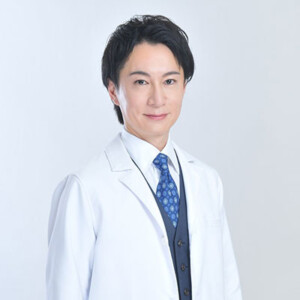
Dr. Jun Karibe
MD
Director
Education & Career
Certifications
Awards
MEDICAL REVIEW