Tyndall Effect and Nodules from HA Filler: How Dissolution Helps

A bluish shadow under the eyes or a small lump that shows up after hyaluronic acid (HA) filler can be upsetting, especially if you are far from the clinic that injected it or unsure where to get help in Tokyo. The good news is that HA filler can usually be broken down. This article explains how dissolving it works, what published studies report, and what to expect if you are treated in Tokyo.
What you’ll learn in this article:
- What the Tyndall effect and filler nodules are, and why they happen
- How hyaluronidase, the enzyme used to dissolve HA filler, works, and its regulatory status in Japan
- What results and side effects clinical studies report
- Current self-pay prices at our clinic group in Tokyo
- Who is a good candidate, and when a different approach is needed first
Have a question about this treatment?
Message us on LINE or WhatsApp — our English-speaking team usually replies the same day.
What Are the Tyndall Effect and Filler Nodules?

The Tyndall effect: a bluish tint
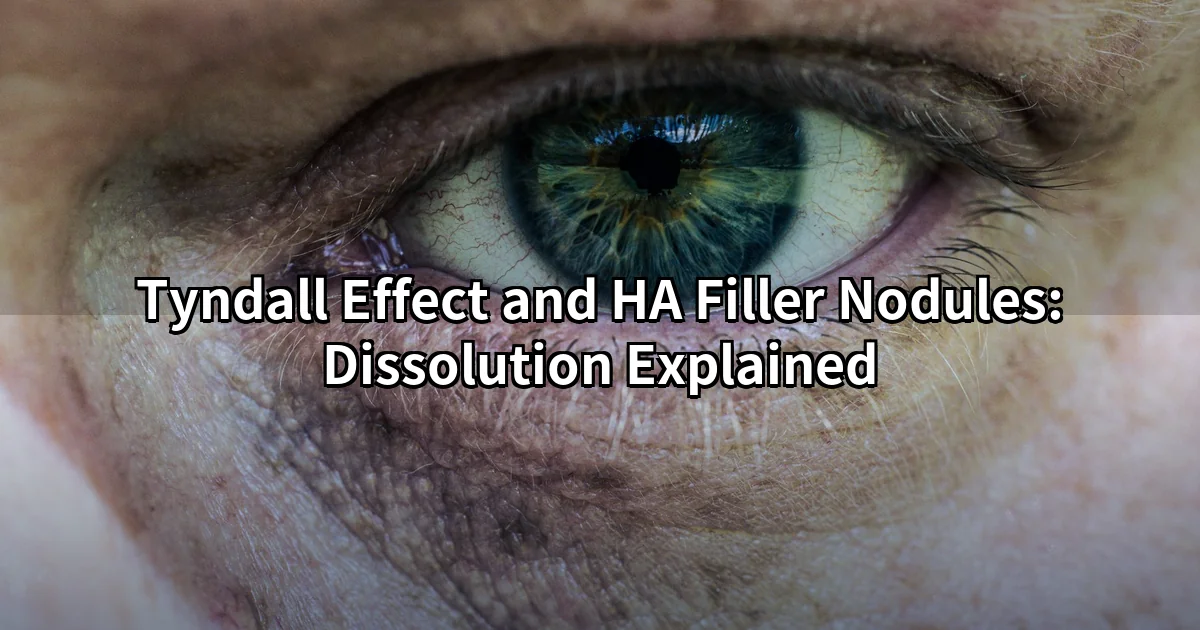
The name comes from a physics phenomenon in which small particles scatter light. A 2024 review in JMIR Dermatology describes it as a bluish discoloration that can appear when particulate HA filler is placed too close to the surface of the skin. It is most noticeable where skin is thin, such as under the eyes. Our group’s own patient information on HA filler also notes that areas injected superficially may look slightly bluish.
Nodules: lumps that are not all alike
A nodule is a firm lump you can feel, and sometimes see, under the skin. Some are simply HA that has collected in one spot. These are called non-inflammatory nodules: they are not red, hot, or painful.
Others are delayed-onset nodules. The same review explains that these are usually inflammatory (the immune system reacting to the filler), granulomatous (a walled-off cluster of immune cells when viewed under a microscope), or linked to infection or biofilm. A biofilm is a protective layer that bacteria form on a surface. The review reports a median onset of around four months after injection.
Hyaluronidase: the dissolving enzyme
Hyaluronidase is an enzyme that breaks down hyaluronic acid. Japan’s aesthetic medicine clinical guideline (FY2021 revision), produced by a Ministry of Health, Labour and Welfare research group together with Japanese specialist societies, states that hyaluronidase is not approved in Japan. When it is used, it is used as an unapproved medicine at the physician’s discretion.
Dissolving filler is also off-label outside Japan. For example, the U.S. FDA-approved label for the hyaluronidase product Hylenex covers uses such as helping other injected drugs spread and absorb, but it does not list dissolving dermal filler as an indication. FDA approval in another country does not mean approval in Japan.
How Dissolution Works
The physician injects small amounts of hyaluronidase directly into the area where the filler sits. The enzyme breaks down the long HA chains, and the body then clears the fragments naturally. The JMIR Dermatology review reports that hyaluronidase acts immediately and has a half-life of about 2 minutes, but it stays clinically active for 24 to 48 hours.
Dose and technique depend on the problem. The review suggests low or moderate doses for the Tyndall effect and non-inflamed nodules. Vascular occlusion, where filler blocks a blood vessel, is an emergency and needs immediate high-dose treatment.
| Problem | Typical signs | General approach reported in the literature |
|---|---|---|
| Tyndall effect | Bluish tint, usually in thin skin (e.g. under the eyes) | Low-to-moderate dose hyaluronidase; a second session is occasionally needed |
| Non-inflammatory nodule | Firm, painless lump with no redness | Low dose with reassessment after about one week |
| Inflammatory or delayed-onset nodule | Tender, red, or swollen lump, often months later | Infection or biofilm addressed first (e.g. oral antibiotics); hyaluronidase and sometimes a steroid injection may follow |
| Vascular occlusion | An urgent problem with blood supply after injection | Emergency high-dose hyaluronidase without delay |
Speed also depends on the product. A 2025 review in Plastic and Reconstructive Surgery Global Open reports that biphasic fillers (made of separate gel particles) may dissolve almost completely within 1 to 2 hours. Monophasic fillers (a smooth, uniform gel) may take up to 24 hours. The Japanese guideline adds that some HA products are harder to break down than others.
Expected Results and Common Misconceptions

For the Tyndall effect, the JMIR Dermatology review reports that low-to-moderate doses often clear the discoloration within 24 hours. Occasionally a second treatment is needed. For non-inflamed nodules, the review describes starting with a low dose and reassessing after about a week, then adjusting if needed. Results vary from person to person and cannot be guaranteed.
Many people worry that the enzyme will damage their own skin. The review notes that hyaluronidase does break down the body’s natural HA, but the body restores it within 15 to 20 hours. The authors report no harmful long-term effects on skin quality.
For context, serious early problems after HA filler appear uncommon. A Japanese observational study of 41,775 patients found early complications in 0.07% of cases, and 27 of the 29 affected patients (93.1%) recovered fully. That study looked at early complications, so it does not measure later concerns such as the Tyndall effect or delayed nodules.
What people often get wrong
- “It is too late to fix filler I had years ago.” Not necessarily. The JMIR Dermatology review notes that hyaluronidase can be used at any time and has worked for Tyndall discoloration 63 months after the original injection.
- “Every lump just needs to be dissolved.” Not always. Inflammatory or infected nodules may need a different first step. One expert recommendation cited in the same review is to try oral antibiotics for at least two weeks before giving high doses of hyaluronidase. The 2025 review also describes combining hyaluronidase with a steroid injection for hard granulomas. A proper diagnosis comes first.
Cost in Tokyo

Filler dissolution is a self-pay cosmetic treatment (jiyū shinryō) and is listed on our group’s cosmetic price list. According to the current public price page for Kojimachi Dermatology & Plastic Surgery Clinic and BIOTOPE CLINIC (checked in September 2026), prices are as follows, tax included:
| Item | Price (tax included) |
|---|---|
| Hyaluronidase, per 0.1 mL (filler placed within our clinic group) | 11,000 yen |
| Hyaluronidase, per 0.1 mL (filler placed at another clinic) | 22,000 yen |
| First-visit or return-visit fee | 3,300 yen |
| Consultation with Dr. Karibe for cosmetic surgery (no nomination fee for cosmetic dermatology) | 2,200 yen |
The total depends on how much filler needs to be dissolved and whether more than one session is needed. If you later decide to have filler again, the same price page lists Allergan HA filler at 88,000 yen for the first syringe. For an accurate quote, please book a consultation.
Have a question about this treatment?
Message us on LINE or WhatsApp — our English-speaking team usually replies the same day.
What to Expect: Before, During & After
Before
If you can, bring details of your original treatment: the product name, the date, and where it was injected. This matters because hyaluronidase acts on hyaluronic acid, and some products break down less easily than others. The physician will also ask about allergies. The JMIR Dermatology review advises checking for bee or wasp sting allergy because of possible cross-reactivity.
A skin test may be considered. The review describes an intradermal test (a tiny injection into the skin) of 0.02 to 0.05 mL. The 2025 review notes that pre-treatment skin testing is recommended but often hard to do routinely in clinics.
During
Hyaluronidase is injected into the affected area, and the dose is matched to the problem being treated. The treatment itself is an injection procedure, not surgery.
After
The JMIR Dermatology review reports that side effects are mainly local: itching, a burning feeling, swelling, redness, and bruising at the injection site. In thin under-eye skin, bruising can occasionally spread beyond where the injection was given. Allergic reactions are uncommon. The review cites rates of 0.03 to 0.13% in eye-area anaesthesia use and around 0.1% for immediate-type reactions at aesthetic doses. The Hylenex FDA label reports hives or swelling in fewer than 0.1% of patients.
A follow-up visit lets the physician check whether more treatment is needed. If you would like filler again, decide the timing with your physician. The review does not set a standard waiting period.
Who Is a Good Candidate?
Dissolution may be suitable if you have:
- A bluish tint where HA filler was injected
- A painless, non-inflamed lump from HA filler
- HA filler results you are unhappy with, such as unevenness or overfilling
Extra caution, or a different approach, may be needed if:
- You have a known allergy to hyaluronidase. The FDA label lists this as a contraindication (a reason not to use it).
- You are allergic to bee or wasp stings. The review recommends an allergist consultation first in non-urgent cases.
- The lump is red, hot, or painful, which suggests inflammation or infection that may need treatment first.
- The filler type is unknown or may not be HA, because hyaluronidase is designed to act on hyaluronic acid.
Important: the Japanese guideline warns that injecting filler into a blood vessel can lead to skin necrosis (tissue death) or vision loss. If you notice a sudden change in your vision or rapidly changing skin after filler, treat it as an emergency. Contact the treating clinic or emergency services straight away.
Where to Get Filler Dissolution in Tokyo
Within our clinic group, both BIOTOPE CLINIC (Shirokanedai, Minato-ku) and Kojimachi Dermatology & Plastic Surgery Clinic (Ichigaya, Chiyoda-ku) offer English-language consultation with Dr. Jun Karibe’s team. Hyaluronidase dissolution for the Tyndall effect and HA filler nodules is handled at BIOTOPE CLINIC (Shirokanedai). Bookings and enquiries in English: LINE or WhatsApp.
Dr. Karibe is a board-certified plastic surgeon (Japan Society of Plastic and Reconstructive Surgery), and his consultations take place at BIOTOPE CLINIC. Once the area has settled, carefully planned HA filler re-treatment is available at BIOTOPE CLINIC in Shirokanedai. Feel free to ask about it during a consultation with Dr. Karibe. For some under-eye concerns, a surgical option such as transconjunctival blepharoplasty (under-eye surgery through the inside of the lower eyelid) may also be discussed. Kojimachi Dermatology & Plastic Surgery Clinic in Ichigaya is the group’s main office for insurance-covered dermatology and general plastic surgery.
Frequently Asked Questions
- Q. How quickly does the bluish Tyndall tint fade after dissolution?
- A 2024 review reports that treatment often clears the discoloration within 24 hours. Occasionally a second session is needed, and individual results vary.
- Q. Will hyaluronidase damage my natural skin?
- The enzyme also breaks down the body’s own HA, but published data suggest the body restores it within 15 to 20 hours. The review authors report no harmful long-term effects on skin quality.
- Q. Is hyaluronidase approved in Japan?
- No. Japan’s aesthetic medicine clinical guideline states that hyaluronidase is not approved in Japan, so it is used as an unapproved medicine at the physician’s discretion. Please ask about the specific product and how it is sourced during your consultation.
- Q. Can you dissolve filler injected at another clinic or overseas?
- Yes, if it is HA filler. Our price list has a separate rate for filler placed elsewhere. Bringing details of the product and injection date helps the physician plan treatment.
- Q. My lump is red and sore. Should I simply have it dissolved?
- Inflamed or delayed-onset nodules may involve infection or biofilm and may need other treatment first, such as antibiotics. Please see a physician promptly for an assessment.
Have a question about this treatment?
Message us on LINE or WhatsApp — our English-speaking team usually replies the same day.
Summary
The Tyndall effect and many HA filler nodules can often be improved with hyaluronidase, even years after injection. Studies suggest the Tyndall tint often clears within about a day, while nodules may need a stepwise, reassessed approach. Inflamed lumps call for diagnosis before dissolution. Hyaluronidase is not approved in Japan, and it should be used by a physician who can manage allergic reactions and complications.
If you have questions about the Tyndall effect or filler nodules, both BIOTOPE CLINIC (Shirokanedai, Minato-ku) and Kojimachi Dermatology & Plastic Surgery Clinic (Ichigaya, Chiyoda-ku) offer English-language consultation with Dr. Karibe and his team. Hyaluronidase filler dissolution is primarily handled at BIOTOPE CLINIC in Shirokanedai. English enquiries: LINE or WhatsApp.
24/7 Consultation & Booking
Book a Consultation or Treatment
Our English-speaking team responds via LINE or WhatsApp — usually the same day.
References
- Kroumpouzos G, Treacy P. Hyaluronidase for Dermal Filler Complications: Review of Applications and Dosage Recommendations. JMIR Dermatology. 2024.
- Yi KH, Wan J, Yoon SE. Considerations for Proper Use of Hyaluronidase in the Management of Hyaluronic Acid Fillers. Plastic and Reconstructive Surgery Global Open. 2025.
- Nishikawa A, Aikawa Y, Kono T. Current Status of Early Complications Caused by Hyaluronic Acid Fillers: Insights From a Descriptive, Observational Study of 41,775 Cases. Aesthetic Surgery Journal. 2023.
- Ministry of Health, Labour and Welfare Research Group on Aesthetic Medicine (in cooperation with JSAPS, JSAD, JSAS, the Japan Society of Plastic and Reconstructive Surgery, and the Japanese Dermatological Association). Aesthetic Medicine Clinical Practice Guideline, FY2021 Revision. Journal of Japan Society of Aesthetic Plastic Surgery, Vol. 44, Special Issue. 2022.
- U.S. Food and Drug Administration. HYLENEX recombinant (hyaluronidase human injection) Prescribing Information. Revised November 2024.
Related Articles
You may also find these articles useful.
- When to Dissolve HA Filler: Signs You Need Hyaluronidase
- Hyaluronidase in Tokyo: A Guide to Dissolving HA Filler
- Hyaluronidase Products Available in Japan: Patient Guide
- Animal vs Human Hyaluronidase: Safety and Allergy Risk
- Under Eye Filler Tokyo: Risks, Benefits & Costs
SUPERVISED BY

Dr. Jun Karibe
MD
Director
Education & Career
Certifications
Awards
MEDICAL REVIEW